
The crypto world is crowded with numbers that can be confusing to even the most ardent investors. Market cap and coin price are two of the most used terms that are easily confused with each other, and that can result in some extremely poor investment choices.
Be it an entry-level crypto user or a long-term observer of Bitcoin, it is crucial to know the distinction between the two metrics. So today, let’s understand both the terms in detail, how they work together, and see a practical example to understand why cheap does not necessarily mean opportunity.
What does Market Cap tell you about a cryptocurrency?
It is basically the total value of a cryptocurrency. It is determined by a very simple formula:

So if a coin is priced at ₹10 and there are 1 billion coins in circulation, the market cap is ₹10 Billion. This single figure informs you much more about the size, dominance and relative worth of a cryptocurrency than its price tag alone can ever do.
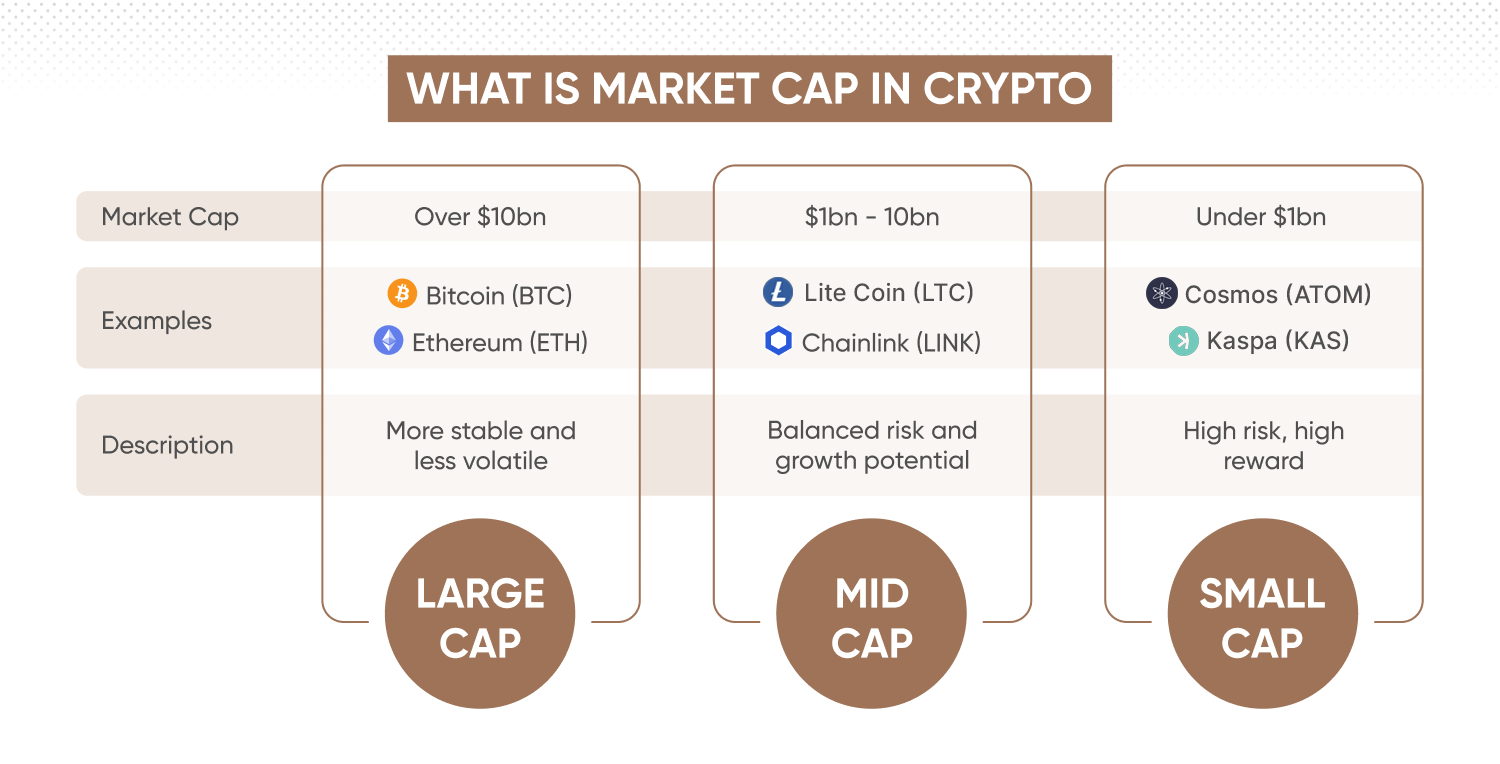
The crypto world is generally categorized in the following way in terms of this metric:
- Large Cap Crypto: Higher capitalization, generally considered stable.
- Mid Cap Crypto: Crypto with moderate market capitalization, has greater growth prospects but is more volatile.
- Small Cap / Micro Cap: Lower capitalization, but highly speculative and risky
In simpler terms, this metric is the sum of all bets that the investor community has made on the value of a project, so it is the best single measure of the position of a coin within the larger ecosystem.
How is Coin Price different? Why does it tend to deceive investors?
The coin price is merely the prevailing trading value of one unit of a cryptocurrency. It is the figure that appears on the exchanges such as SunCrypto and others. It is instinctive that less expensive appears more affordable and more costly appears more valuable. This is where the novice investors fail.
A coin that costs ₹0.001 will not essentially be a better or cheaper purchase than one worth ₹50,000. The price of coins alone is almost meaningless without the knowledge of supply. A token containing a trillion coins in circulation will always sell at a low price per unit, not due to being undervalued but because its value is being divided through an astronomical number of units.
It is a classic trap: seeing a low coin price and assuming there’s room to grow to ₹1, ₹10, or beyond, without doing the math.
What is the relation between Market Cap and Coin Price?
The relationship between market cap and coin price is direct but not linear. The price of the coin goes up when demand increases, and more people purchase the coin, and so the capitalization too goes up, assuming that the supply does not change. Nevertheless, the price of the coins can fall when new coins are minted or put into circulation (which is common to many projects) despite the other metric remaining unchanged or increasing.
This means:
- An increase in the price of coins with a fixed supply = increasing capitalization (healthy sign).
- A falling price with a widening supply = stagnant or falling capitalization (red flag).
- Low price and huge supply = potentially enormous market cap even at “low” prices
Let us understand this correlation in detail with a case study of Shiba Inu.
Why will Shiba Inu likely never hit ₹1?
Shiba Inu (SHIB) has one of the highest token supplies of any cryptocurrency that has ever been minted; around 589 trillion coins in circulation (some have been burned). Even after significant burn events, the supply remains staggeringly high.
Now, let’s do the math. For SHIB to reach just ₹1 per coin:
₹1 × 589,000,000,000,000 = ₹589 trillion market cap
In comparison, the total global GDP, or the total economic output of all nations on Earth, is about ₹10,000 trillion (approximately $120 trillion). A ₹1 price of SHIB would demand a capitalization of approximately 5 times the economic output of the whole world in a year. It’s not just unlikely; it’s mathematically impossible under any realistic scenario.
This is the classic illusion that occurs when investors consider price without paying attention to the market cap. SHIB at ₹0.001163 (estimated current value) is already a billion-dollar capitalization. To reach ₹1, require capital inflows that don’t exist anywhere on the planet.
It does not imply that SHIB is worthless or has no future; however, the illusion of it reaching ₹1 is constructed with a fundamental misconception about the interaction between these two metrics.
Conclusion
Knowing the difference between market cap and coin price is one of the most valuable lessons a crypto investor can acquire. The price is only skin deep – it tells you the price of one unit at this time, no more. The other metric, however, is an indicator that shows the real size and physical presence of a cryptocurrency.
The case of Shiba Inu is a good example of how the low price of a coin may give a false impression of an enormous rise, and the calculations of the capitalization will tell quite another story. Before buying into the next “cheap coin that could hit ₹1,” always run the numbers.
Disclaimer: Crypto products and NFTs are unregulated and can be highly risky. There may be no regulatory recourse for any loss from such transactions.
Frequently Asked Questions
What is the current price of Pi Coin?
As of April 22, 2026, the Pi coin is approximately ₹15.84–₹15.96.
What is the price of the Jio Coin?
As of April 2026, there is no official, publicly traded “Jio Coin” or cryptocurrency issued by Reliance Jio.
What is the current price of Bitcoin?
As of April 22, 2026, the price of Bitcoin is ₹73,24,287.27